
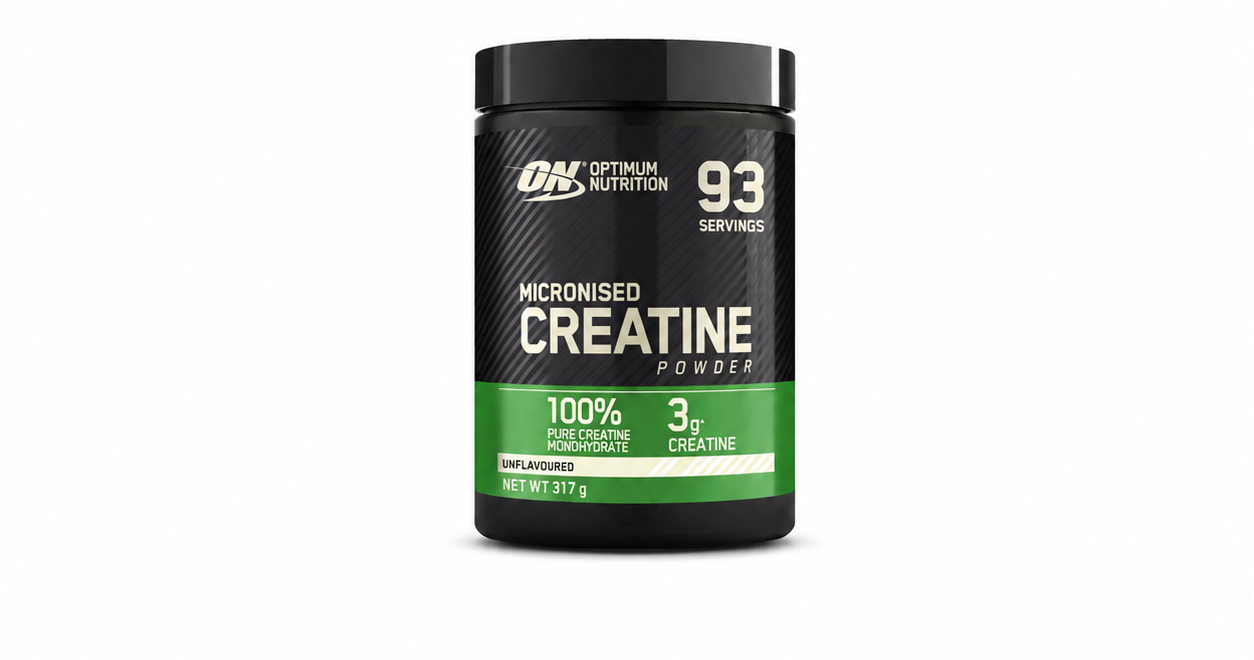
The best-selling creatine on Amazon UK, and one of the few supplements where the science is not the weak link. One ingredient, no filler, no invented mechanism. The argument is about the size of the scoop and what the listing declines to tell you.
What one scoop contains
The pack arithmetic is sound. A 317 g tub divided by a 3.4 g scoop gives 93 servings, exactly as claimed. That is more than most of this category manages.
The wording is not. The product description says each serving provides “3g of creatine monohydrate”, while the directions say the scoop is 3.4 g. Both figures are real; they describe different things.
That coincidence is worth sitting with. The dose is not a formulation decision arrived at from the literature. It is the smallest amount that lets the pack make its claim.
Three grams or five?
Three grams a day does work. It maintains raised muscle creatine stores, and the widely used maintenance formula of 0.03 g per kg of bodyweight puts a 100 kg lifter at almost exactly 3 g. Nobody following this pack is wasting their money.
But the bulk of the research did not use 3 g. Most strength and lean-mass trials settled on 5 g a day, often after a loading week at around 20 g, and 5 g is the figure the International Society of Sports Nutrition position stand centres on.
The instruction “one serving per day” is the real shortfall. There is no loading option, no mention of bodyweight, and no distinction between a 55 kg beginner and a 95 kg powerlifter. Creatine is one of the few supplements where dose guidance is genuinely settled, and the pack gives none of it.
The evidence, for once, is strong
Most supplements have to be marked down for thin trials. This one does not. Creatine monohydrate is among the most heavily studied compounds in sports nutrition, with hundreds of randomised trials behind it, and the effects are consistent: improvements of roughly 5–15% in output during short, repeated, high-intensity work, and gains of about one to two kilograms of lean mass over a few weeks of training, some of it intracellular water.
The authorised UK claim — increased physical performance in successive bursts of short-term, high-intensity exercise — is one of the few sports-nutrition claims that reflects what the trials actually showed rather than a stretch from them.
Two honest limits. Around a fifth to a third of people respond little, because their muscle stores are already near saturation; vegetarians, whose baseline is lower, tend to respond most. And the cognitive benefits now widely promoted rest on far weaker evidence than the performance ones, mostly in sleep-deprived or low-intake groups.
On safety, one reviewer here warns that overdosing “may result in renal failure”. That is worth correcting. Creatine has been studied in healthy adults for up to five years without evidence of kidney damage. It does raise serum creatinine, because creatine breaks down into creatinine, and that can make a routine blood test look alarming without anything being wrong. Anyone with existing kidney disease is a different case and should ask a doctor.
What the listing doesn’t say
A one-line ingredient list is inherently transparent. There is no blend to hide behind and no percentage to misread. What is missing sits alongside it.
No purity specification is given. Creatine monohydrate can carry manufacturing impurities such as creatinine and dicyandiamide, which is why some brands publish a specification or license Creapure. Nothing of the kind appears here, and no third-party testing is mentioned at all. Two competing products listed on the same page — one Creapure, one Informed Choice certified — do state theirs. For a tested athlete that gap is decisive.
The allergen line deserves a mention too: a single-ingredient powder that may contain milk, gluten, egg, soy, nuts and peanuts is a shared-facility declaration, and someone with coeliac disease or a nut allergy would reasonably not expect it here.
Finally, the safety warning excludes anyone with a pre-existing medical condition or taking any medication. Read literally that rules out a large share of adults, including anyone on a statin. Blanket wording of that breadth protects the manufacturer and tells the buyer nothing useful.
What buyers report
Amazon’s topic breakdown, from a much larger sample, contains one figure that stands out.
Verdict
- Works
- One ingredient, no fillers, no proprietary blend
- 93 servings from 317 g — the arithmetic checks out
- Micronised: mixability 76 mentions to 4
- Unflavoured, so it goes into anything
- The compound with the strongest evidence in sports nutrition
- Three pack sizes; scoop included
- Doesn’t
- “3 g of creatine monohydrate” is the wrong noun for the right number
- 3 g is the claim minimum, not the 5 g most trials used
- No loading phase or bodyweight guidance given
- No purity specification, Creapure or sport certification
- Rivals on the same page publish theirs
- May contain six allergens despite one ingredient
- Safety warning excludes anyone on any medication
- Scoop is too small to measure 5 g in one go
Worth it if you want plain creatine monohydrate from a large brand, you mix it into a shake anyway, and you are willing to use a scoop and a half rather than the one the pack suggests.
Skip it if you compete under anti-doping rules and need a certified batch; if you want a published purity specification; if you have coeliac disease or a nut allergy; or if you can buy an identical single-ingredient powder cheaper, which on this evidence you often can.
Check with a pharmacist if you have kidney disease or reduced kidney function, take nephrotoxic medication or diuretics, are pregnant or breastfeeding, or are under 18 — the pack excludes all of these.
How we score
Every supplement in this section is judged on the same six criteria, weighted as below. We score the product that left the factory — the formula, the dose, the pack — not the way a retailer has written the listing. Marketing wording is worth pointing out, and we do, but it does not move the score.
Each criterion is scored out of 10 against the norm for its category, not against an ideal: 10 is best practice, 8 solid with minor gaps, 6 works but with a real limitation, 4 a serious shortfall, 2 should not be on the shelf. The overall figure is the weighted average, printed to one decimal place, and the paragraph under the table explains where the marks went.
How we review: every supplement is scored on the same six criteria — formulation 25%, dosing against the evidence 25%, real-world record 20%, value 15%, practicality 10%, transparency 5%. The real-world score reflects the product’s customer rating and, just as importantly, how many ratings stand behind it: tens of thousands of buyers tell you something a desk review cannot, while a few hundred tell you very little. We buy nothing from the brands we cover and take no payment for placement. General information, not medical advice.