
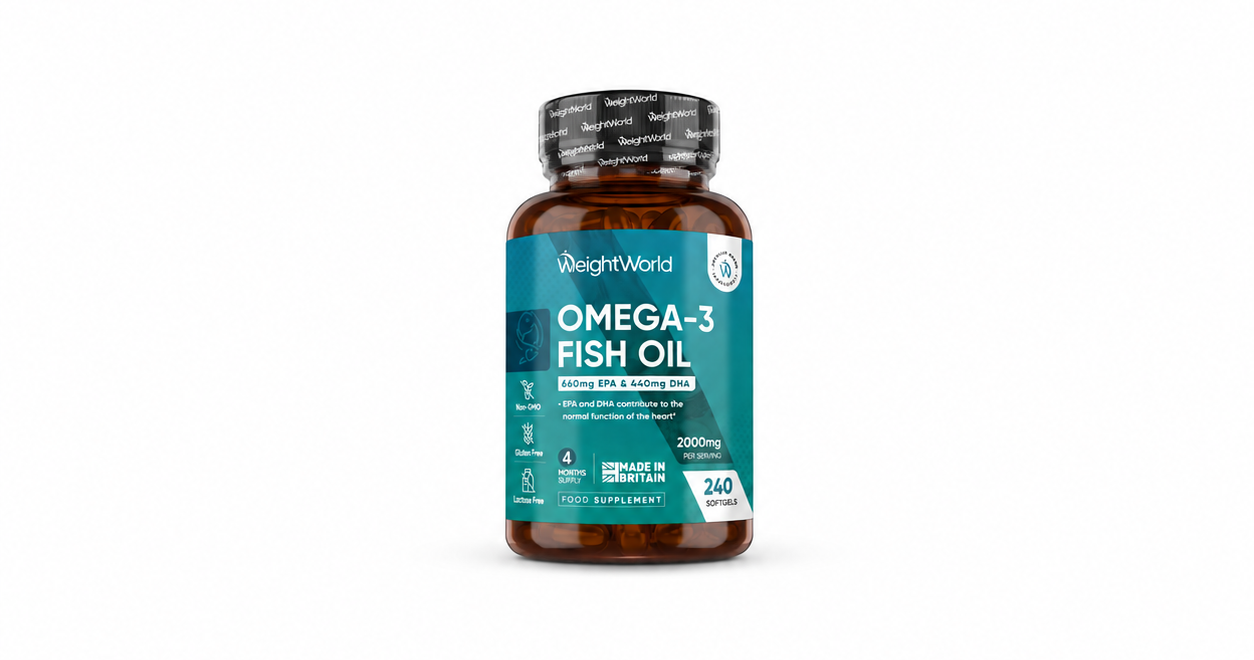
A concentrated fish oil at the numbers this category has settled on — 2,000 mg of oil, 660 mg EPA, 440 mg DHA. It gets the arithmetic right without ever doing the addition for you, and leaves out the sourcing detail its own reviewers have started supplying on its behalf.
The sum nobody prints
Start with what this listing avoids. The title reads “Omega 3 Fish Oil 2000mg — 660mg EPA & 440mg DHA”, and the first bullet says each serving contains 2,000 mg of fish oil. That wording is correct, and it is more than much of this category manages — listings with identical figures routinely promise “2000mg of Omega-3”, presenting the oil weight as the active.


What it never does is finish the thought.
The ingredient list is otherwise a good one: fish oil, mixed tocopherols as antioxidant, and a bovine gelatin shell with glycerin and water. The antioxidant matters, because a 55% concentrate oxidises, and its presence is a real point in the product’s favour. Bovine gelatin is disclosed in the ingredients, though not flagged in a bullet as making the product unsuitable for vegetarians.
Three correct claims, one wrong authority
The third bullet quotes the authorised wordings accurately: EPA and DHA contribute to the normal function of the heart; DHA contributes to the maintenance of normal brain function; DHA contributes to the maintenance of normal vision. All three need 250 mg daily and all three are met several times over. No blood-pressure claim appears, which is correct — that one requires 3 g a day.
Then it attributes them to “EFSA Approved Claims”. Since Brexit, EFSA is not the authority that governs claims in Great Britain; the GB nutrition and health claims register is. The claims themselves are identical, so nothing misleading is being said about the product. But citing the wrong regulator on a UK listing is the kind of detail that separates a brand keeping its copy current from one that has not revisited it in six years.
One bullet headline is also an absolute: “NO FISHY AFTERTASTE OR BURPS”. Fish-oil tolerance varies between people, and no formulation can promise that for everyone. On this listing’s own data the claim broadly holds — taste runs 17 positive mentions to 5.
What the listing leaves out
Here is the gap, and it is a real one. There is no species, no fishery, no country of catch, no sustainability certification and no third-party testing claim. GMP is mentioned, but GMP is a manufacturing process standard — it says the batch was made consistently, not that anyone analysed it. Competing fish oils at this price routinely name their species, carry a sustainability certification such as Friend of the Sea, and some name their testing laboratory.
The interesting part is what fills the vacuum.
Those reviewers may be right — the physical bottle may carry more than the page does. They may also be importing details from the near-identical products sitting in the same “customers also viewed” strip, both of which do name anchovies. Either way, a listing that stays silent on sourcing invites its customers to guess, and they guess generously.
What 1,100 mg supports
Two softgels give 7.7 g of EPA and DHA a week, comparable to two or three portions of oily fish, which is more than most UK adults eat.
What that achieves is where the category needs honesty. The two largest prevention trials, VITAL and ASCEND, together enrolled over 41,000 people at 840 mg a day — close to this dose — and found no significant reduction in major cardiovascular events. The single large trial that did show benefit used 4 g a day of a purified EPA-only prescription drug in high-risk patients, and its placebo choice remains disputed. Pooled analyses have also linked omega-3 supplementation to a small rise in atrial fibrillation risk, clearest above about 1 g a day.
So the supportable statement is the modest one printed on the pack: contributing to normal heart function. Preventing heart disease is a different claim at a different dose, and to its credit this listing does not make it.
What buyers report
Amazon’s topic breakdown agrees on value and taste, and turns negative on two attributes — with an important caveat about how few people said so.
Verdict
- Works
- Title carries 660 mg and 440 mg, not just the oil weight
- Bullet correctly says 2,000 mg of fish oil
- Mixed tocopherols antioxidant in the formula
- Quotes the three authorised claims accurately
- Does not reach for the blood-pressure claim
- 240 softgels — four months; value 50 mentions to 6
- Taste holds up: 17 positive mentions to 5
- Doesn’t
- Never states the 1,100 mg omega-3 total
- No species, fishery or sustainability certification
- No third-party testing claim — GMP is not a test
- Cites EFSA, which no longer governs GB claims
- “No fishy aftertaste or burps” is an absolute promise
- Triglyceride or ethyl ester form not stated
- Pill size and digestive effects both majority-negative
- Four months is a long time for an open bottle of fish oil
Worth it if you rarely eat oily fish, you want a large, well-preserved bottle at a real EPA and DHA dose, and sourcing certification is not something you need on the label.
Skip it if you want the species and fishery named, or a sustainability certification, or published testing, all of which some competitors do carry; if large softgels have defeated you before; if you need a vegetarian or algal source; or if you are buying it to prevent heart disease rather than top up a shortfall.
Check with a pharmacist if you take anticoagulants or antiplatelet drugs, have atrial fibrillation or another arrhythmia, are due surgery, or are pregnant or breastfeeding.
How we score
Every supplement in this section is judged on the same six criteria, weighted as below. We score the product that left the factory — the formula, the dose, the pack — not the way a retailer has written the listing. Marketing wording is worth pointing out, and we do, but it does not move the score.
Each criterion is scored out of 10 against the norm for its category, not against an ideal: 10 is best practice, 8 solid with minor gaps, 6 works but with a real limitation, 4 a serious shortfall, 2 should not be on the shelf. The overall figure is the weighted average, printed to one decimal place, and the paragraph under the table explains where the marks went.
How we review: every supplement is scored on the same six criteria — formulation 25%, dosing against the evidence 25%, real-world record 20%, value 15%, practicality 10%, transparency 5%. The real-world score reflects the product’s customer rating and, just as importantly, how many ratings stand behind it: tens of thousands of buyers tell you something a desk review cannot, while a few hundred tell you very little. We buy nothing from the brands we cover and take no payment for placement. General information, not medical advice.