
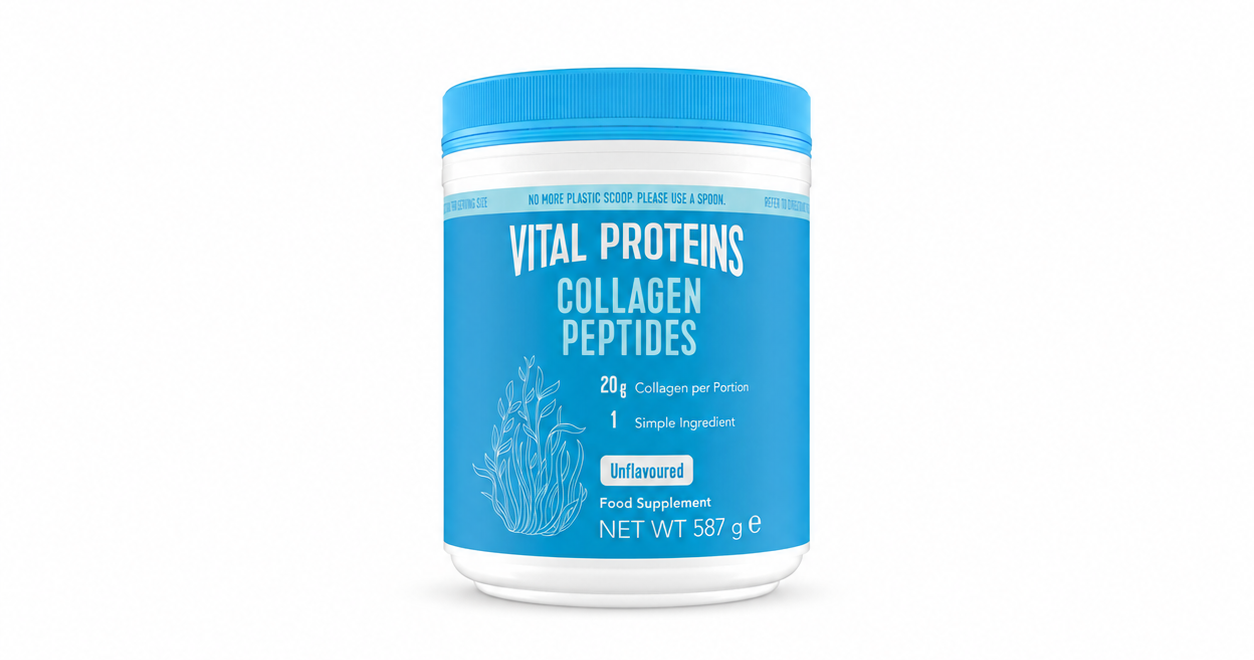
The best-known collagen brand in the world, in a 587 g tub, at a 20 g daily serving several times larger than most collagen powders recommend. The dose is the whole story: it is above what the trials used, and it is why the tub lasts a month.
What “one simple ingredient” tells you
The brand’s own graphic promises “One Simple Ingredient”, and the arithmetic behind the pack is sound: 587 g divided by a 20 g serving gives the 29 servings claimed. So far so good.
Then you read the ingredient field.
The consequence shows up in the reviews. One detailed five-star review is titled “Best Marine Collagen product I’ve bought in a while”. It is not marine. Anyone avoiding beef for religious or dietary reasons, or choosing marine collagen deliberately, cannot settle the question from this page.
Nothing else is quantified either — no protein per serving, no energy value, no amino acid breakdown. And the specification block lists the unit count as 567 g against an item weight of 587 g, which is the kind of small inconsistency that suggests nobody proofread it.
20 g, and what the trials used
This is one of the rare supplements that is arguably dosed too high rather than too low, and the distinction matters because the buyer pays for it.
The bullet itself says “10–20g recommended for daily wellness”, which quietly concedes that half this serving would do. Nobody is being short-changed on collagen; the question is whether the second 10 g buys anything the first did not, and on the published evidence there is no reason to think so.
A three-star reviewer reached the same place from the other direction, noting it is a high dose compared with other collagen powders she had used and that this is what makes it expensive. She is right, and it is the single most useful observation in the review section.
Hair, skin and nails are not authorised claims
Amazon tags the product benefits as hair support, skin support and nail support. The bullets promise a blend “crafted to provide key support for radiant hair, skin, and nails”.
There are no authorised health claims for collagen in Great Britain — none for skin, hair, nails or joints. This applies across the category rather than to one brand. It does not make the claims false. It means no regulator has assessed the evidence and found it sufficient.
Two other phrases are worth naming. “Bioavailable Collagen Peptides: Maximum benefit, swift absorption” is a superlative with nothing published behind it on this page. And “Paleo” and “Non-GMO” are unregulated marketing terms that tell you nothing about peptide size, purity or testing — and no third-party testing is mentioned anywhere.
Going scoopless
The fifth bullet announces that Vital Proteins has removed the scoop as a packaging improvement, and that dosing is “now measured in tablespoons”. Four tablespoons make the 20 g serving.
Powder measured by volume is not powder measured by weight. How much collagen fits in a tablespoon depends on how compressed it is and how finely it is milled, and the error compounds across four spoonfuls. For a product whose central selling point is a precise 20 g, replacing a calibrated scoop with a piece of cutlery is a step backwards presented as a step forward. Anyone who cares about the number should weigh it.
The wider practicality picture is better. It dissolves in hot coffee, which not every collagen does, and it is genuinely unflavoured for most people — six of the ten reviews read here say so unprompted.
What buyers report
Amazon’s topic breakdown, from a larger sample, lands on the same complaint from a different angle.
Verdict
- Works
- Single ingredient, no fillers or flavourings
- Type I and III rather than Type I alone
- Dissolves in hot coffee — solubility 29 mentions to 8
- Six of ten reviews call it genuinely tasteless
- 587 g divided by 20 g really is 29 servings
- Bullet honestly states 10–20 g as the useful range
- Doesn’t
- Ingredient statement is the single word “Collagen”
- Species and tissue never stated — a reviewer thinks it is marine
- 20 g is above the 2.5–10 g used in trials
- Value for money is majority-negative, 45 of 88
- No protein, energy or amino acid figures
- Scoop removed; four tablespoons is not a measurement
- Hair, skin and nail claims are not authorised
- “Maximum benefit, swift absorption” unsupported
- No third-party testing mentioned; 567 g and 587 g both stated
Worth it if you want a large tub of plain collagen from a brand with a long track record, you take it in hot drinks, and you are content to use 10 g rather than the 20 g on the label — which doubles the tub’s life and matches the trials more closely.
Skip it if you need to know the species, for religious, allergy or ethical reasons; if you specifically want marine collagen; if you want a named or characterised peptide; if you want a scoop; or if cost per day matters, since the serving size is what drives it.
Check with a pharmacist if you have a history of kidney stones, since collagen is high in hydroxyproline and oxalate precursors, if you are on a protein-restricted diet, or if you have a beef allergy — which this listing gives you no way to rule out.
How we score
Every supplement in this section is judged on the same six criteria, weighted as below. We score the product that left the factory — the formula, the dose, the pack — not the way a retailer has written the listing. Marketing wording is worth pointing out, and we do, but it does not move the score.
Each criterion is scored out of 10 against the norm for its category, not against an ideal: 10 is best practice, 8 solid with minor gaps, 6 works but with a real limitation, 4 a serious shortfall, 2 should not be on the shelf. The overall figure is the weighted average, printed to one decimal place, and the paragraph under the table explains where the marks went.
How we review: every supplement is scored on the same six criteria — formulation 25%, dosing against the evidence 25%, real-world record 20%, value 15%, practicality 10%, transparency 5%. The real-world score reflects the product’s customer rating and, just as importantly, how many ratings stand behind it: tens of thousands of buyers tell you something a desk review cannot, while a few hundred tell you very little. We buy nothing from the brands we cover and take no payment for placement. General information, not medical advice.