
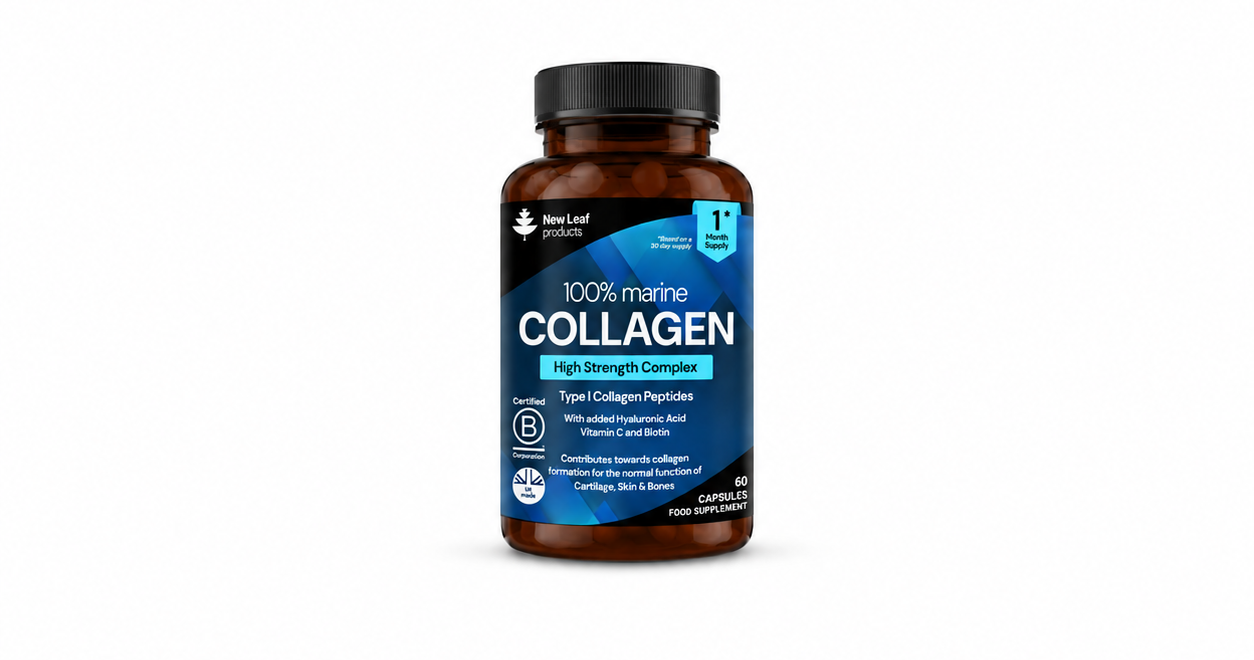
One of the most completely disclosed collagen labels on the UK market, and one of the smallest collagen doses — 1,060 mg a day, against the 2.5 to 10 grams the trials used. A three-star reviewer worked that out before we did, and she is right.
What two capsules contain
Start with what this listing does well, because disclosure is where most of this category falls down.

All four actives are quantified per serving, with reference values where they exist. The source is stated as fish rather than left to inference, the capsule shell is named, and heavy-metal testing and BRC Grade AA packing are both specified. Nothing has to be guessed, which is why transparency scores as high as it does.
The problem is the first number.
One title claim does not survive contact with that figure either. “Essential Amino Acids” appears in the product name, but collagen contains no tryptophan, so it does not supply the full essential set — and at one gram the amino acid contribution is nutritionally trivial in any case.
1,060 mg against the trials
The randomised trials that found improvements in skin hydration and elasticity generally used 2.5 to 10 g of hydrolysed collagen daily, most often with characterised, patented peptides. Joint studies clustered nearer 5 to 10 g. Nothing in that literature tested a gram.
This is not our inference. A Spanish reviewer awarded three stars, listed the exact composition, praised the vitamin C and hyaluronic acid amounts, then wrote that the collagen falls short: skin studies used 2.5–5 g, joint studies 5–10 g, and she would look for at least 2.5 g. It is the most useful review on this listing.
To be fair to the formula, the supporting nutrients are not token. Vitamin C at 80 mg is a full reference intake and is genuinely required to build collagen; hyaluronic acid at 100 mg sits within the range used in the small oral-HA studies; biotin at 300% is generous. Only the headline ingredient is under-dosed.
Which ingredient earns the skin claim
There are no authorised health claims for collagen in Great Britain, and none for hyaluronic acid. So the skin and hair language on this page has to come from somewhere else, and the brand is unusually open about where.
The bullet quotes that claim almost verbatim, which is more discipline than either of the other collagen listings showed. The awkwardness is placement: it sits immediately after the biotin figure, so a reader could take it as a biotin claim.
One passage is looser. The hyaluronic acid bullet describes HA acting “as a cushion and lubricant in the joints and other tissues”. True of the hyaluronic acid your body already makes; not demonstrated for 100 mg swallowed in a capsule. Describing the physiology of a substance is not the same as showing that supplementing it reaches the joint.
Why capsules cap the dose
The under-dosing is not a marketing decision so much as a physical one, and Amazon’s own review data shows the constraint biting.
That trade-off is worth stating plainly rather than treating capsules as simply a worse powder. Reviewers here chose capsules for a reason: one abandoned collagen drinks because they were unpleasant and she kept forgetting them. A gram taken daily beats five grams abandoned in a cupboard — but it still is not the dose the research supports.
Swallowability runs 71 positive to 43 and taste 37 to 23. Marine collagen is prone to a fishy note, and two reviewers in our sample describe a faint taste of the sea.
What buyers report
Verdict
- Works
- All four actives quantified, with reference values
- Fish source and capsule material both stated plainly
- Vitamin C at a full 100% NRV — genuinely needed for collagen synthesis
- Hyaluronic acid at 100 mg, within the studied range
- Quotes the authorised vitamin C claim almost verbatim
- Heavy-metal testing, BRC Grade AA, B Corp all named
- Two capsules is a habit people actually keep
- Doesn’t
- 1,060 mg of collagen — below every studied dose
- Five to ten capsules a day would be needed to match the trials
- Tablet size negative in 95 of 117 mentions
- “Essential Amino Acids” — collagen has no tryptophan
- Hyaluronic acid described by what endogenous HA does
- No peptide characterisation or molecular weight
- Testing laboratory not named
- Faint marine smell and taste for some
Worth it if you want a convenient daily capsule for skin and hair whose claims genuinely rest on the vitamin C and biotin inside it, you have tried collagen powders and abandoned them, and you are not expecting the collagen itself to do the work.
Skip it if you are buying it for the collagen dose, in which case a powder at 5 to 10 g is the only format that gets you there; if large capsules are a problem; if you want a named or characterised peptide; if you are vegetarian or vegan; or if you already take a multivitamin supplying vitamin C and biotin, which is most of what you are paying for here.
Check with a pharmacist if you have a fish allergy, a history of kidney stones, or are on a protein-restricted diet, and mention any biotin supplement before blood tests, since biotin can interfere with some laboratory assays at higher doses than this one.
How we score
Every supplement in this section is judged on the same six criteria, weighted as below. We score the product that left the factory — the formula, the dose, the pack — not the way a retailer has written the listing. Marketing wording is worth pointing out, and we do, but it does not move the score.
Each criterion is scored out of 10 against the norm for its category, not against an ideal: 10 is best practice, 8 solid with minor gaps, 6 works but with a real limitation, 4 a serious shortfall, 2 should not be on the shelf. The overall figure is the weighted average, printed to one decimal place, and the paragraph under the table explains where the marks went.
How we review: every supplement is scored on the same six criteria — formulation 25%, dosing against the evidence 25%, real-world record 20%, value 15%, practicality 10%, transparency 5%. The real-world score reflects the product’s customer rating and, just as importantly, how many ratings stand behind it: tens of thousands of buyers tell you something a desk review cannot, while a few hundred tell you very little. We buy nothing from the brands we cover and take no payment for placement. General information, not medical advice.