
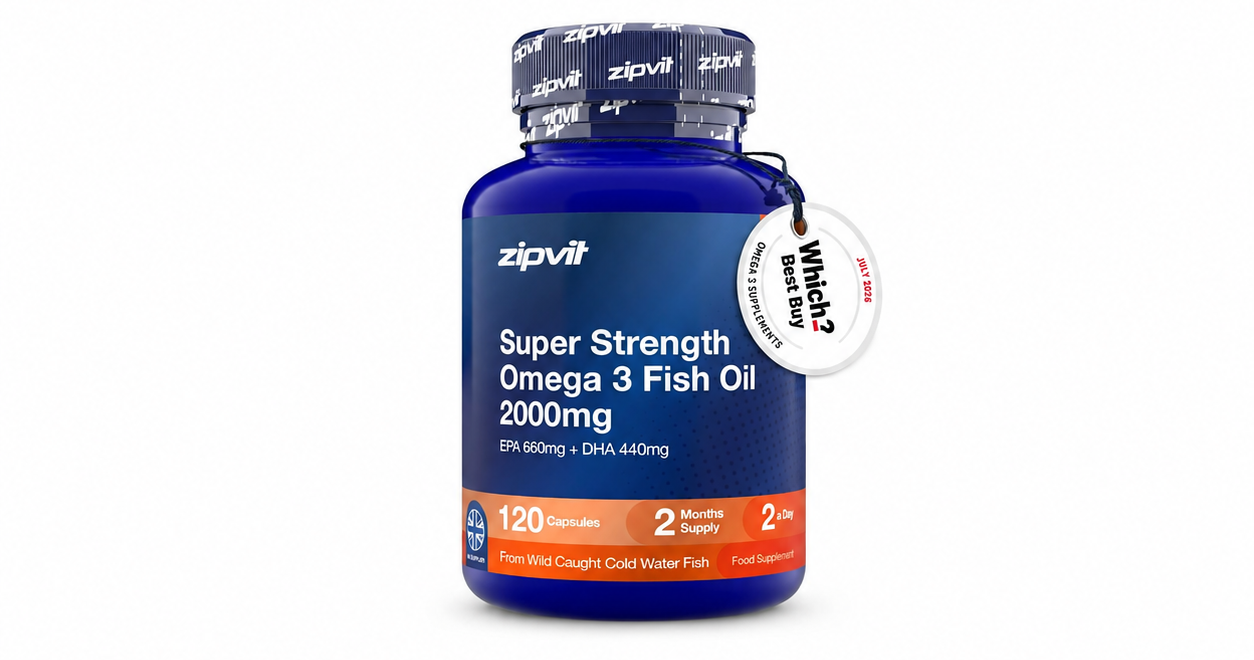
The best-selling omega-3 on Amazon UK, and a genuinely strong dose: 1,100 mg of EPA and DHA a day, third-party tested, sustainably certified. The headline figure is still wrong, and the trials behind the promise are weaker than the packaging suggests.
What “2000 mg” means
The first bullet promises “a powerful 2000mg of Omega-3 per serving”. The brand’s own ingredient list contradicts it: fish oil, 33% EPA and 22% DHA. Those percentages are of the oil, not of the omega-3.

This is the same pattern seen across supplements, where compound weight is presented as active weight. What makes it worse here is that the correct number was already on the pack. A reader who trusts the bullet will think they are taking almost twice the omega-3 they actually are.
To be fair on the underlying oil: at 55% omega-3, this is a concentrate. A standard fish oil runs nearer 30%, which is why a plain “1,000 mg fish oil” capsule typically carries only about 300 mg of EPA and DHA against 550 mg here.
1,100 mg a day, in context
The dose is the product’s strongest feature. Two softgels deliver 7.7 g of EPA and DHA a week, comparable to two or three portions of oily fish — more than the NHS recommendation of one oily portion weekly, which most UK adults do not reach.
It clears the authorised claim thresholds comfortably. Heart function requires 250 mg of EPA and DHA daily; brain function and vision each require 250 mg of DHA. At 1,100 mg and 440 mg, all three are earned, and the listing is entitled to make them.
One tag on the listing is not earned. Under “product benefits” Amazon shows Blood Pressure, and the authorised claim for blood pressure requires 3 g of EPA and DHA a day — nearly three times what two softgels provide. Reaching it would mean six capsules, which the pack does not sanction.
A German reviewer made the opposite point, that two a day is more than many people need and would be far too much for a child. Both cautions are reasonable. UK guidance suggests staying below 3 g a day of supplemental EPA and DHA, so a single capsule is a legitimate option for anyone who also eats fish.
What the large trials found
Here the honest answer is unflattering, and it applies to the category rather than to Zipvit specifically.
The one large trial that did show benefit, REDUCE-IT, used 4 g a day of a purified EPA-only prescription drug in high-risk patients, and its placebo choice remains disputed. A parallel trial at 4 g of combined EPA and DHA was stopped for futility. So the evidence favouring omega-3 sits at four times this dose, in a different molecule, in a sicker population.
There is also a signal in the other direction: pooled analyses have linked omega-3 supplementation to a modest increase in atrial fibrillation risk, apparently dose-dependent and clearest above about 1 g a day. Anyone with a known arrhythmia should raise it with a doctor rather than assume fish oil is neutral.
None of this makes the authorised claims false. “Contributes to the maintenance of normal heart function” is a much weaker statement than preventing heart attacks, and only the first is on the label. The gap between the two is where most fish-oil marketing lives.
What “independently tested” covers
Zipvit names its laboratory, which few brands in this category do: Eurofins, testing for heavy metals. That is a real disclosure and it earns credit.
It also covers the wrong problem. Heavy metals in refined fish oil are rarely the failure point; oxidation is. Fish oil goes rancid, independent surveys have repeatedly found products on sale above the industry’s own freshness limits, and oxidised oil is both unpleasant and possibly counterproductive. No peroxide value, anisidine value or TOTOX figure is published here.
Two further gaps. The listing does not say whether the oil is in triglyceride or ethyl ester form, which affects absorption and matters more in a concentrate than in a plain oil. And no antioxidant — usually mixed tocopherols — appears anywhere on the published ingredient list, which for a concentrated fish oil is a conspicuous absence rather than a detail. It may simply be omitted from the Amazon copy; the pack itself would settle it.
What buyers report
Amazon’s topic breakdown, from a much larger sample, is where the tolerability picture sharpens.
Verdict
- Works
- 1,100 mg EPA and DHA daily — a real dose, not a token
- Real EPA and DHA figures printed in the title
- Testing laboratory named, not just “third-party tested”
- Species, fishery and Friend of the Sea certification stated
- 55% concentrate, roughly double a standard fish oil
- Four ingredients, no fillers; 60 days per jar
- Doesn’t
- “2000mg of Omega-3” is oil weight — the omega-3 is 1,100 mg
- Contradicts its own ingredient list
- “Blood Pressure” benefit needs 3 g a day, not 1.1 g
- Large trials at this dose found no event reduction
- Testing covers heavy metals, not oxidation
- Triglyceride or ethyl ester form not stated
- No antioxidant on the published ingredient list
- Capsule size is the only majority-negative theme
- Fish gelatin — not suitable for vegetarians
Worth it if you rarely eat oily fish, you want a high EPA and DHA dose from a named and certified fishery, and you are buying it for the modest maintenance claims on the label rather than for disease prevention.
Skip it if you already eat oily fish twice a week; if large softgels are a problem; if you want published freshness data or a stated oil form; if you need a vegetarian or algal source; or if you are buying it to lower blood pressure, which would take nearly three times this dose.
Check with a pharmacist if you take anticoagulants or antiplatelet drugs, have atrial fibrillation or another arrhythmia, are due surgery, are pregnant or breastfeeding, or are considering giving these to a child.
How we score
Every supplement in this section is judged on the same six criteria, weighted as below. We score the product that left the factory — the formula, the dose, the pack — not the way a retailer has written the listing. Marketing wording is worth pointing out, and we do, but it does not move the score.
Each criterion is scored out of 10 against the norm for its category, not against an ideal: 10 is best practice, 8 solid with minor gaps, 6 works but with a real limitation, 4 a serious shortfall, 2 should not be on the shelf. The overall figure is the weighted average, printed to one decimal place, and the paragraph under the table explains where the marks went.
How we review: every supplement is scored on the same six criteria — formulation 25%, dosing against the evidence 25%, real-world record 20%, value 15%, practicality 10%, transparency 5%. The real-world score reflects the product’s customer rating and, just as importantly, how many ratings stand behind it: tens of thousands of buyers tell you something a desk review cannot, while a few hundred tell you very little. We buy nothing from the brands we cover and take no payment for placement. General information, not medical advice.