
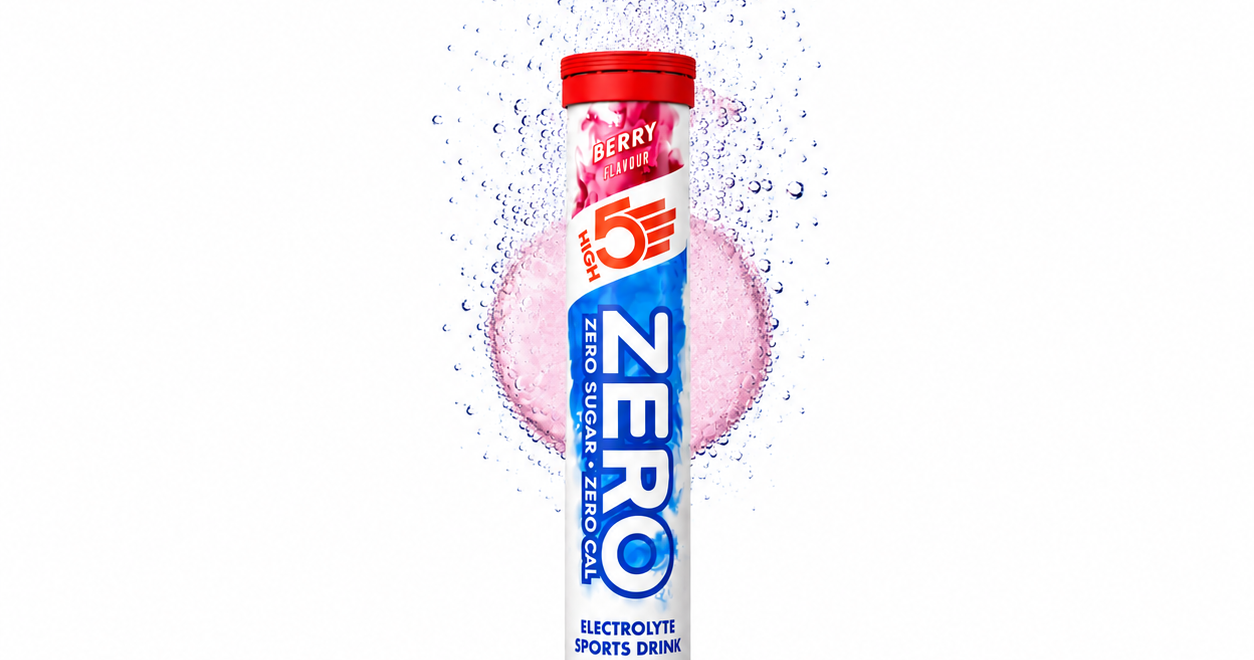
The number one electrolyte tablet on Amazon UK, with an unusually honest label — every mineral quantified, every percentage correct. The question the label answers plainly is one the marketing avoids: at 333 mg of sodium per litre, this is a flavoured drink first and a sweat-replacement second.
The label
Start with the part that deserves credit. All five minerals are quantified per tablet with reference intakes, and every percentage checks out against the UK figures: vitamin C 28 mg is 35% of 80 mg, magnesium 56 mg is 15% of 375 mg, potassium 70 mg is 3.5% of 2,000 mg. Nothing is hidden behind a blend. After a category where headline numbers routinely mean something other than they appear to, that is worth saying plainly.
Then there is the decoration. Green tea extract appears at 1 mg per tablet and is listed on the Amazon specification as a “special ingredient”; trials of green tea extract use doses in the hundreds of milligrams, so 1 mg is a line on an ingredient list rather than an active. Leucine and curcuma powder are not quantified at all. Calcium is the third piece of padding: 9 mg is 1.1% of a day’s reference intake, and calcium is barely lost in sweat anyway. Counting it among the electrolytes makes the list look fuller than it works.
The sodium arithmetic
Sodium is the mineral that matters in a hydration drink, and this is where the product and its marketing part company. One tablet in 750 ml of water, as directed, gives 333 mg per litre.
There is a regulatory yardstick too. The authorised GB claim about maintaining endurance performance and improving water absorption during exercise applies to carbohydrate-electrolyte solutions, and sets conditions: sodium between 20 and 50 mmol per litre, which is roughly 460–1,150 mg, plus 80–350 kcal per litre from carbohydrate. This drink sits at about 14.5 mmol per litre and zero calories. It misses both conditions, which is why that specific claim appears nowhere on the pack.
None of this makes the product defective. It makes it a different product from the one the bullet points imply. For a hot office, a long flight, a hangover or a 45-minute gym session, 333 mg per litre is a sensible amount of salt. For a marathon in July it is thin, and athletes who need real replacement generally reach for products at three to five times this concentration.
What the claims rest on
The listing promises “reduced fatigue and enhanced endurance”, immune support and protection from oxidative stress. Checked one at a time, the picture is mixed rather than damning.
Fatigue, immunity and oxidative stress are on solid ground — but not because of the electrolytes. Authorised claims exist for magnesium contributing to a reduction in tiredness and fatigue, and for vitamin C in immune function and protection of cells from oxidative stress. Both need at least 15% of the reference intake per serving; at 15% and 35% the tablet qualifies. So the legal footing of most of this label is 56 mg of magnesium and 28 mg of vitamin C.
“Superior hydration and fluid balance over water alone” is the weak one. For someone sweating heavily, a little sodium does help retain fluid. For someone at a desk, the evidence that a dilute electrolyte drink hydrates better than water is not there, and no authorised claim covers it.
“Enhanced endurance” belongs to carbohydrate drinks. The ergogenic ingredient in sports drinks is the carbohydrate, and this product has removed it by design. HIGH5 sells that separately.
Three a day, and what that adds up to
The pack permits three tablets daily. Worth doing the sum, because the marketing suggests all-day use.
Magnesium is the second thing to watch. Three tablets give 168 mg, which is 42% of the 400 mg a day the UK Expert Group on Vitamins and Minerals considers a safe upper level for supplements. Comfortable alone, but not alongside a magnesium supplement: a typical three-in-one magnesium product supplies close to the whole allowance by itself.
The pack also warns that excessive consumption may produce laxative effects. That is the standard warning triggered by polyol content, and sorbitol is the fourth ingredient here; magnesium carbonate contributes as well. It is a real limit rather than boilerplate, and it explains why the ceiling is three.
What buyers report
Amazon’s topic breakdown, from a far larger sample, is unusually one-sided.
Verdict
- Works
- Every mineral quantified, every %RI correct
- Sodium as bicarbonate, citrate and chloride — sensible salts
- 15 litres of drink per 20-tablet tube
- Tolerability is the strongest theme, 122 mentions to 12
- 11 flavours, six pack sizes, tube fits a bag
- UK made, vegetarian, no sugar or carbohydrate
- Doesn’t
- 333 mg sodium per litre is below what sweat carries
- Misses both conditions of the endurance claim
- “Superior hydration over water alone” unsupported at rest
- 1 mg green tea extract listed as a special ingredient
- Calcium at 1.1% RI is padding
- Leucine and turmeric amounts not disclosed
- Three a day is 31% of the UK salt maximum
- No third-party testing stated; no price on the listing
Worth it if you want water you will actually drink in hot weather, on flights, while fasting or after a moderate session, and you value a label that states its amounts honestly.
Skip it if you sweat heavily for hours and need real sodium replacement, in which case look for three to five times this concentration; if you want carbohydrate for endurance; if you already take a magnesium supplement; if you are watching salt intake for blood pressure; or if you expect 1 mg of green tea to do something.
Check with a pharmacist if you have high blood pressure or are on a sodium-restricted diet, have reduced kidney function, take potassium-sparing diuretics or ACE inhibitors, or are giving these to a child.
How we score
Every supplement in this section is judged on the same six criteria, weighted as below. We score the product that left the factory — the formula, the dose, the pack — not the way a retailer has written the listing. Marketing wording is worth pointing out, and we do, but it does not move the score.
Each criterion is scored out of 10 against the norm for its category, not against an ideal: 10 is best practice, 8 solid with minor gaps, 6 works but with a real limitation, 4 a serious shortfall, 2 should not be on the shelf. The overall figure is the weighted average, printed to one decimal place, and the paragraph under the table explains where the marks went.
How we review: every supplement is scored on the same six criteria — formulation 25%, dosing against the evidence 25%, real-world record 20%, value 15%, practicality 10%, transparency 5%. The real-world score reflects the product’s customer rating and, just as importantly, how many ratings stand behind it: tens of thousands of buyers tell you something a desk review cannot, while a few hundred tell you very little. We buy nothing from the brands we cover and take no payment for placement. General information, not medical advice.