
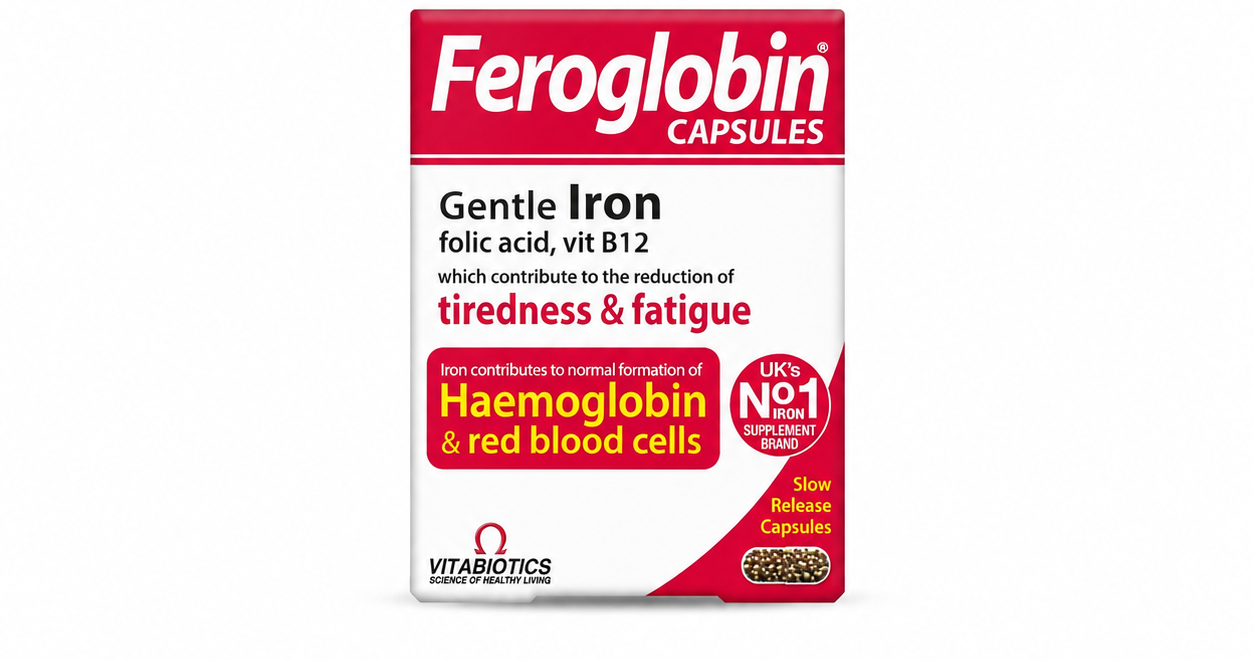
A long-established, genuinely gentle iron capsule from a serious British manufacturer — sold on a listing that does not state how much iron is in it. For an iron supplement, that omission shapes most of this review.
What the listing does not tell you
Most supplement reviews start from numbers. This one cannot.
Iron is the one supplement where the number decides everything. It determines whether a mild shortfall gets corrected, and it determines whether the person taking it spends the month constipated. A buyer cannot make that judgement from this page — though the physical pack is legally required to declare it, so the failure here is the listing rather than the product.
The word “organic” compounds it. The first bullet promises an “organic form of iron”; the ingredient is ferrous fumarate. That is organic in the chemist’s sense, meaning the iron is bound to a carbon-containing acid rather than a sulphate. It has nothing to do with organic farming, which is what most shoppers will read. Ferrous fumarate is a perfectly respectable choice — better tolerated than ferrous sulphate at equivalent iron — and it does not need the word.
Smaller errors suggest the page has not been checked. The ingredient panel is headed “Tablet Ingredients” on a capsule product. “Box Contains” says 200 ml of liquid. The title misspells “deficiency”.
“Anemia” is not a claim a supplement may make
The listing title says the product supports “Iron Defficiency, Anemia and Blood Formation”. The first two are conditions, not functions.
UK law permits a food supplement to make only authorised claims, and for iron those are specific: contributing to the normal formation of red blood cells and haemoglobin, normal oxygen transport, the reduction of tiredness and fatigue, normal cognitive function, normal immune function and a role in cell division. None of them mentions anaemia, and a food supplement may not claim to treat, prevent or cure a disease at all.
Vitabiotics’ own product description is careful and stays inside those wordings almost verbatim. The offending line sits in the Amazon title, which reads as retailer copy rather than brand copy — the misspelling points the same way. That distinction matters for who is at fault. It does not help the person reading the page, who sees the title first.
Gentleness has a cost
The tolerability claim is real, and reviewers back it. But the two design choices that deliver it both work against absorption, and the listing never says so.
There is no vitamin C in the formula, which is the cheapest and best-evidenced way to raise iron absorption from a non-meat source. Two reviewers worked out the caffeine timing for themselves — one leaves an hour either side, another 60 to 90 minutes — which is exactly the guidance the label should be giving and does not.
A separate point on frequency: a single iron dose raises hepcidin, the hormone that limits further absorption, for much of the following day. That has led to interest in alternate-day dosing being more efficient than daily. The evidence is still developing, but “one capsule daily” is not obviously the optimum it is presented as.
Why a blood test comes first
This is the part that matters more than the score. Iron deficiency anaemia is a symptom, not a diagnosis. NHS guidance is to investigate the cause, because it can point to coeliac disease, heavy menstrual bleeding or bleeding in the gut. Buying a supplement because you feel tired can delay that.
Iron also has a ceiling. The UK Expert Group on Vitamins and Minerals sets a guidance level of 17 mg a day for supplemental iron, above which gastrointestinal effects become likely. Reference intakes are 8.7 mg for men and 14.8 mg for women aged 19 to 50.
Around one person in 200 of northern European descent carries the genetics for haemochromatosis and stores iron they cannot excrete. Folic acid can also mask a B12 deficiency, though the inclusion of B12 here reduces that risk. All of which argues for a ferritin test before a purchase, not after.
What buyers report
Verdict
- Works
- Ferrous fumarate is better tolerated than ferrous sulphate
- Iron with copper, B6, B12 and folate is a coherent combination
- Copper offsets zinc’s effect on copper status
- Tolerability is confirmed by reviewers, including a critical one
- One small, tasteless capsule a day
- Established manufacturer, UK based, long track record
- Doesn’t
- No amount stated for iron or any other nutrient on the listing
- “Organic form of iron” means ferrous fumarate, not organic farming
- Title claims to support anaemia — not a permitted claim
- Full stomach and slow release both reduce absorption
- No vitamin C to aid uptake; no guidance on tea or coffee
- Bovine gelatin capsule — not suitable for vegetarians
- Listing mixes capsules with liquid; “Box Contains 200ml”
- No way to check the 17 mg EVM guidance level
Worth it if a doctor has confirmed you need iron, you have already abandoned ferrous sulphate because of side effects, and tolerability matters more to you than speed of correction.
Skip it if you have not had a blood test; if you are vegetarian or vegan, since the capsule shell is bovine; if you have a diagnosed deficiency and need a therapeutic dose; or if you want to know how much iron you are taking, which this listing will not tell you.
Check with a pharmacist before starting, and specifically if you take levothyroxine, bisphosphonates, tetracycline or quinolone antibiotics, proton pump inhibitors or levodopa, if you have haemochromatosis or a family history of it, if you are pregnant, or before giving iron to a child — iron is a leading cause of accidental poisoning in young children.
How we score
Every supplement in this section is judged on the same six criteria, weighted as below. We score the product that left the factory — the formula, the dose, the pack — not the way a retailer has written the listing. Marketing wording is worth pointing out, and we do, but it does not move the score.
Each criterion is scored out of 10 against the norm for its category, not against an ideal: 10 is best practice, 8 solid with minor gaps, 6 works but with a real limitation, 4 a serious shortfall, 2 should not be on the shelf. The overall figure is the weighted average, printed to one decimal place, and the paragraph under the table explains where the marks went.
How we review: every supplement is scored on the same six criteria — formulation 25%, dosing against the evidence 25%, real-world record 20%, value 15%, practicality 10%, transparency 5%. The real-world score reflects the product’s customer rating and, just as importantly, how many ratings stand behind it: tens of thousands of buyers tell you something a desk review cannot, while a few hundred tell you very little. We buy nothing from the brands we cover and take no payment for placement. General information, not medical advice.