
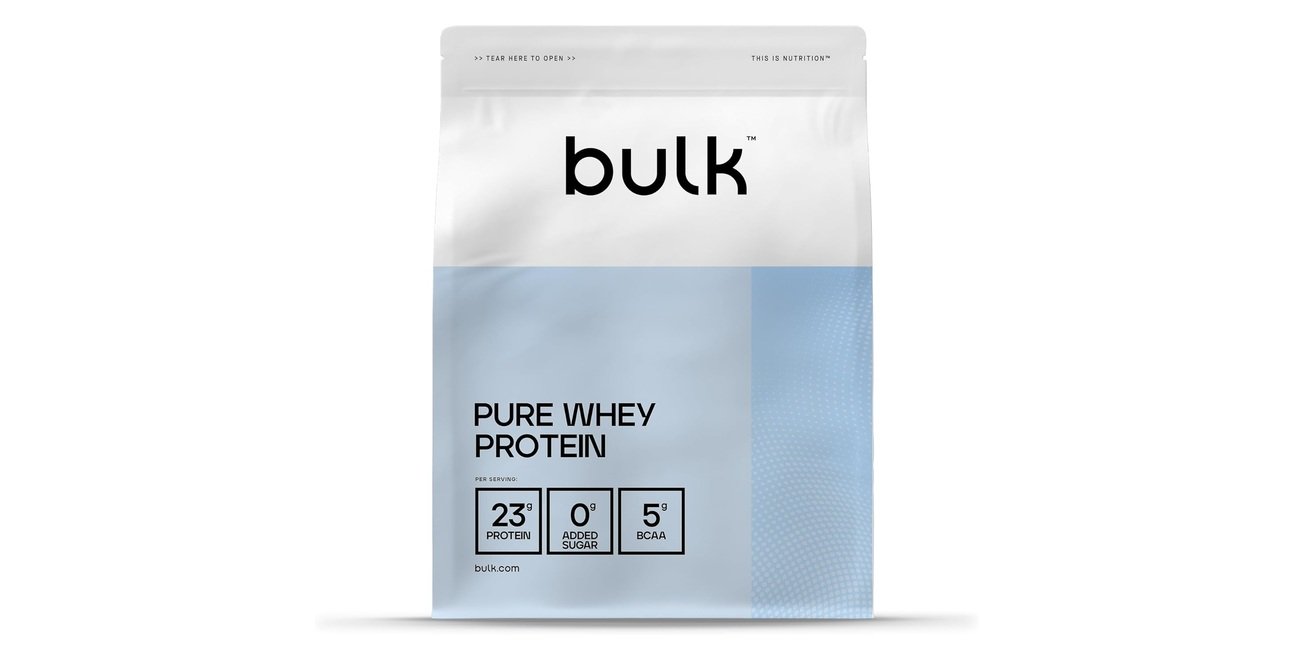
The best-selling whey protein on Amazon UK, and one of the plainest labels in the category — five ingredients, no blend, nothing hidden. What needs checking is not the pouch. It is the price per gram of protein, and a nutrition panel the listing never shows.
The label
Five ingredients: whey protein concentrate, sunflower lecithin, flavourings, xanthan gum, sucralose. No proprietary blend, no filler amino acids, no long list of actives that do nothing. For this category that is a good label, and it is the main reason the product scores well on formulation.

What is missing is the panel. The listing gives protein and BCAAs and nothing else: no energy, carbohydrate, sugars, fat or salt per serving. For a product whose own title carries a Low Sugar claim, that absence is the single biggest transparency problem here, and it is why transparency scores 5 rather than 8.
The bullets also hedge: “22g or 23g of protein per serving (depending on flavour).” The vanilla page then commits to 23 g. If it were the lower figure, every price-per-gram below is 4% worse.
Is 23 g the right dose?
Yes — this is the part the product gets right. Around 20–25 g of whey is the dose used in most muscle-protein-synthesis work, chosen because it supplies roughly 2–3 g of leucine, the amount generally needed to switch the response on. Whey is about 21–26% branched-chain amino acids, so the 5 g of BCAAs claimed here carries roughly 2.5 g of leucine. The arithmetic holds.
That frame cuts both ways. The UK reference intake is 0.75 g per kg of bodyweight and national diet surveys show most British adults already exceed it. An 80 kg lifter aiming at 1.6 g/kg needs about 130 g a day, and one scoop moves them 23 g closer. Someone not training gains nothing food would not also give.
The directions are the weak point: “have 1–3 servings daily.” That is a range, not guidance. Three servings is 69 g of supplemental protein a day, which for most people would be well past useful.
What the claims are allowed to say
Three claims sit in the product title, and they are not equally solid.
“Supports Muscle Growth and Repair.” The authorised GB claims for protein cover growth and maintenance of muscle mass, and maintenance of normal bones. Repair is not among them. The product easily meets the compositional threshold to make a protein claim at all — the drift is in the wording, not the substance, but it is in the title of a best-seller.
“Low Sugar.” This is a regulated term: no more than 5 g of sugars per 100 g. Whey concentrate retains lactose, typically somewhere near that threshold before flavouring is added. Plausible, then, but unverifiable from the listing, because the sugars figure is not published there.
“5g BCAAs, naturally occurring.” Accurate, and the phrasing is to Bulk’s credit — nothing has been added. It is worth knowing that BCAAs taken on their own have repeatedly underperformed complete protein in trials. Inside a whole whey they are simply a description of the whey, not a second ingredient.
What the protein really costs
At £29.99 for 1 kg: 97p a serving, and £4.21 per 100 g of protein. Subscribe & Save at 15% brings that to 82p and £3.57. Those are mid-market numbers, not budget ones, and the 1 kg pouch is the worst value in the range — the same powder is sold on the same listing in 2.5 kg and 5 kg sizes at a lower price per kilo.
Price on this listing also moves a great deal. One reviewer records paying £13.99, then seeing £21.99 a fortnight later; the £29.99 recorded here is higher again. Anyone comparing should check the current figure rather than trust a review.
What buyers report
Amazon’s own topic breakdown, from a far larger sample, agrees on mixing and taste and diverges on one point.
Verdict
- Works
- Five-ingredient label, no proprietary blend
- 23 g and about 2.5 g leucine per scoop — a real dose
- Mixing is the most-praised trait, 8 of 10 reviews
- BCAA figure honestly marked as naturally occurring
- UK made, 17 flavours, four pack sizes, scoop included
- Doesn’t
- No nutrition panel on the listing at all
- “Low Sugar” therefore cannot be verified
- “Repair” is not an authorised protein claim
- £4.21 per 100 g protein — 1 kg is the worst-value size
- No third-party or batch testing stated
- Concentrate keeps its lactose; digestibility is the one negative theme
- “1–3 servings daily” is a range, not guidance
Worth it if you train and are genuinely short of daily protein, you want a plain whey with nothing extra in it, and you buy the 2.5 kg or 5 kg pouch or use Subscribe & Save.
Skip it if you already hit your protein target from food; if lactose is a problem, in which case pay more for an isolate; if you need a published nutrition panel or third-party testing before buying; if you are a tested athlete and need certification on the pack; or if you want a strong vanilla, since the most common flavour complaint runs in both directions at once.
Check with a pharmacist if you have reduced kidney function, are on a protein-restricted diet, have a cow’s milk allergy rather than lactose intolerance, or are pregnant and unsure about sucralose intake.
How we score
Every supplement in this section is judged on the same six criteria, weighted as below. We score the product that left the factory — the formula, the dose, the pack — not the way a retailer has written the listing. Marketing wording is worth pointing out, and we do, but it does not move the score.
Each criterion is scored out of 10 against the norm for its category, not against an ideal: 10 is best practice, 8 solid with minor gaps, 6 works but with a real limitation, 4 a serious shortfall, 2 should not be on the shelf. The overall figure is the weighted average, printed to one decimal place, and the paragraph under the table explains where the marks went.
How we review: every supplement is scored on the same six criteria — formulation 25%, dosing against the evidence 25%, real-world record 20%, value 15%, practicality 10%, transparency 5%. The real-world score reflects the product’s customer rating and, just as importantly, how many ratings stand behind it: tens of thousands of buyers tell you something a desk review cannot, while a few hundred tell you very little. We buy nothing from the brands we cover and take no payment for placement. General information, not medical advice.