
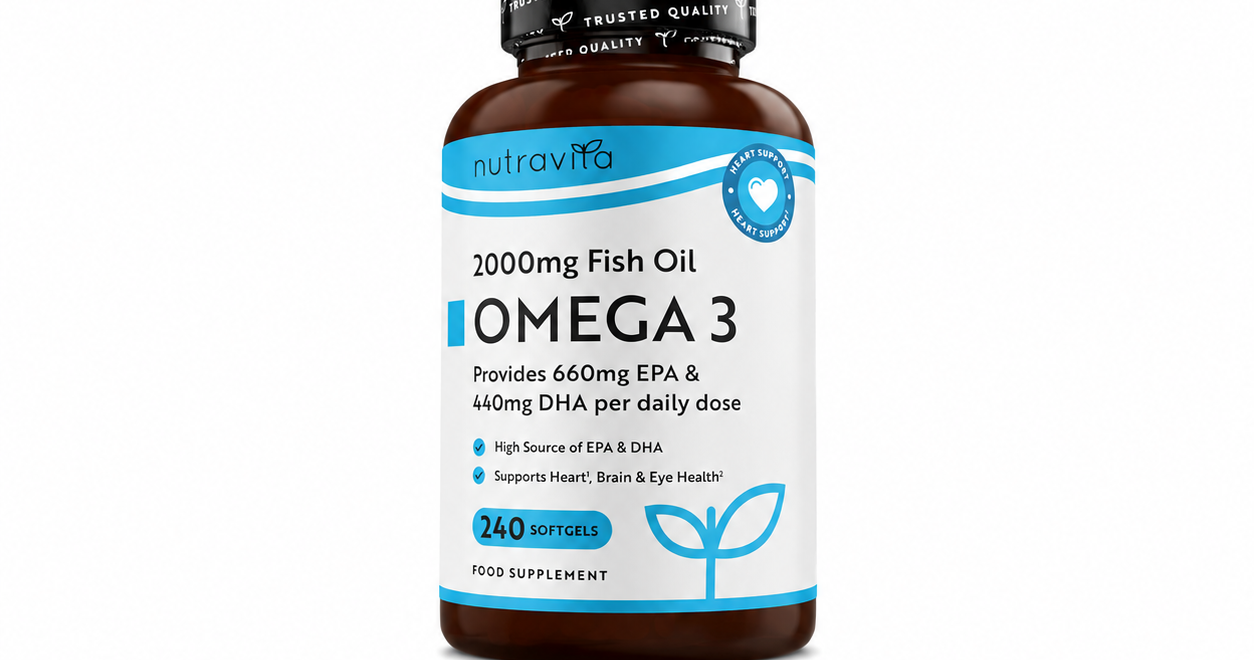
The numbers this category has settled on — 2,000 mg of oil, 660 mg EPA, 440 mg DHA — on a listing that states them correctly, explains the difference between the two figures, and claims only what the dose supports. Most of its competitors do at least one of those things badly.
The label done right
Almost every fish oil listing leaves you to unpick its headline figure. This one does the unpicking itself, in its own first bullet.


The comparison is not hypothetical. Fish oils with exactly these 660 mg and 440 mg figures are commonly sold with a first bullet promising “2000mg of Omega-3” — the oil weight presented as the active. Same oil specification, opposite editorial choice.
The ingredient list adds a piece many concentrates leave out: a tocopherol-rich extract as antioxidant. Fish oil oxidises, and a concentrate needs protection. Its presence here is a small line that matters more than it looks.
One blemish, in an older description block further down the page: “contains contaminant free, pure fish oil”. No oil is contaminant-free; testing shows levels below limits, not zero. It reads like legacy copy the precise new bullets have overtaken.
Three claims, and the one they left out
The second bullet names its own legal basis: at this serving three authorised claims apply — EPA and DHA for normal heart function, DHA for maintenance of normal brain function, DHA for maintenance of normal vision. All three require 250 mg daily, and all three are comfortably met.
What is absent is as telling. Blood pressure does not appear. The authorised blood-pressure claim requires 3 g of EPA and DHA a day, nearly three times what two softgels give, and Nutravita has not reached for it. Listings at this dose frequently tag it anyway.
The safety text also states plainly that the product is not intended to treat, cure or prevent any disease, that it is not suitable for under-18s, and — unusually — that the softgel shell is bovine gelatine and therefore unsuitable for vegetarians and vegans. Brands are not obliged to volunteer the last one in a bullet. Most do not.
What 1,100 mg can and cannot promise
The dose is real. Two softgels give 7.7 g of EPA and DHA a week, roughly two to three portions of oily fish, which is more than most UK adults manage.
The evidence for what that achieves is where honesty is required, and it applies to the category rather than the brand.
So the supportable statement is the one on the pack: contributing to the normal function of the heart. Preventing heart attacks is a different claim, and this dose does not carry it. Pooled analyses have also linked omega-3 supplementation to a small increase in atrial fibrillation risk, apparently clearest above about 1 g a day, which is worth raising with a doctor if you have an arrhythmia.
Read that way, the listing and the evidence are in step. That is rarer than it should be.
What “batch tested” covers
Every batch is independently tested for heavy metals and microbiological safety, and the oil is molecularly distilled. Good, and stated more specifically than most.
It still covers the wrong failure. Rancidity, not contamination, is the recurring problem in fish oil, and independent surveys have repeatedly found products on sale above the industry’s own freshness limits. No peroxide value, anisidine value or TOTOX figure appears here. The tocopherol helps; published numbers would settle it.
Two smaller gaps. The laboratory is not named, which some competitors do. And the oil form — triglyceride or ethyl ester — is not stated, which affects absorption and matters in a 55% concentrate. A four-month bottle also means an opened container of fish oil for a third of a year; keeping it cool and sealed is not a trivial instruction.
What buyers report
Amazon’s topic breakdown, from a far larger sample, disagrees with those thirteen on one point — sharply.
Verdict
- Works
- States 2,000 mg of oil of which 1,100 mg omega-3, and explains why
- Quotes the exact authorised claim wordings
- Does not reach for the blood-pressure claim it cannot make
- Tocopherol antioxidant in the formula
- Discloses bovine gelatine and unsuitability for vegetarians
- Species, fishery, certification and country all named
- Batch tested for heavy metals and microbiology
- 240 softgels — four months; value 477 mentions to 28
- Doesn’t
- Odour is majority-negative, against its own marketing
- Capsule size negative in 56 of 126 mentions
- No oxidation, peroxide or TOTOX figures
- Testing laboratory not named
- Triglyceride or ethyl ester form not stated
- “Contaminant free” in an older description block
- Large trials at this dose found no event reduction
- Four months is a long time for an open bottle of fish oil
Worth it if you rarely eat oily fish, you want a high EPA and DHA dose from a named and certified fishery, and you value a brand that tells you what the numbers mean rather than choosing the flattering one.
Skip it if you already eat oily fish twice a week; if large softgels or fishy repeating have defeated you before; if you want published freshness data or a stated oil form; if you need a vegetarian or algal source; or if you are buying it to prevent heart disease rather than to top up a shortfall.
Check with a pharmacist if you take anticoagulants or antiplatelet drugs, have atrial fibrillation or another arrhythmia, are due surgery, or are pregnant or breastfeeding.
How we score
Every supplement in this section is judged on the same six criteria, weighted as below. We score the product that left the factory — the formula, the dose, the pack — not the way a retailer has written the listing. Marketing wording is worth pointing out, and we do, but it does not move the score.
Each criterion is scored out of 10 against the norm for its category, not against an ideal: 10 is best practice, 8 solid with minor gaps, 6 works but with a real limitation, 4 a serious shortfall, 2 should not be on the shelf. The overall figure is the weighted average, printed to one decimal place, and the paragraph under the table explains where the marks went.
How we review: every supplement is scored on the same six criteria — formulation 25%, dosing against the evidence 25%, real-world record 20%, value 15%, practicality 10%, transparency 5%. The real-world score reflects the product’s customer rating and, just as importantly, how many ratings stand behind it: tens of thousands of buyers tell you something a desk review cannot, while a few hundred tell you very little. We buy nothing from the brands we cover and take no payment for placement. General information, not medical advice.