
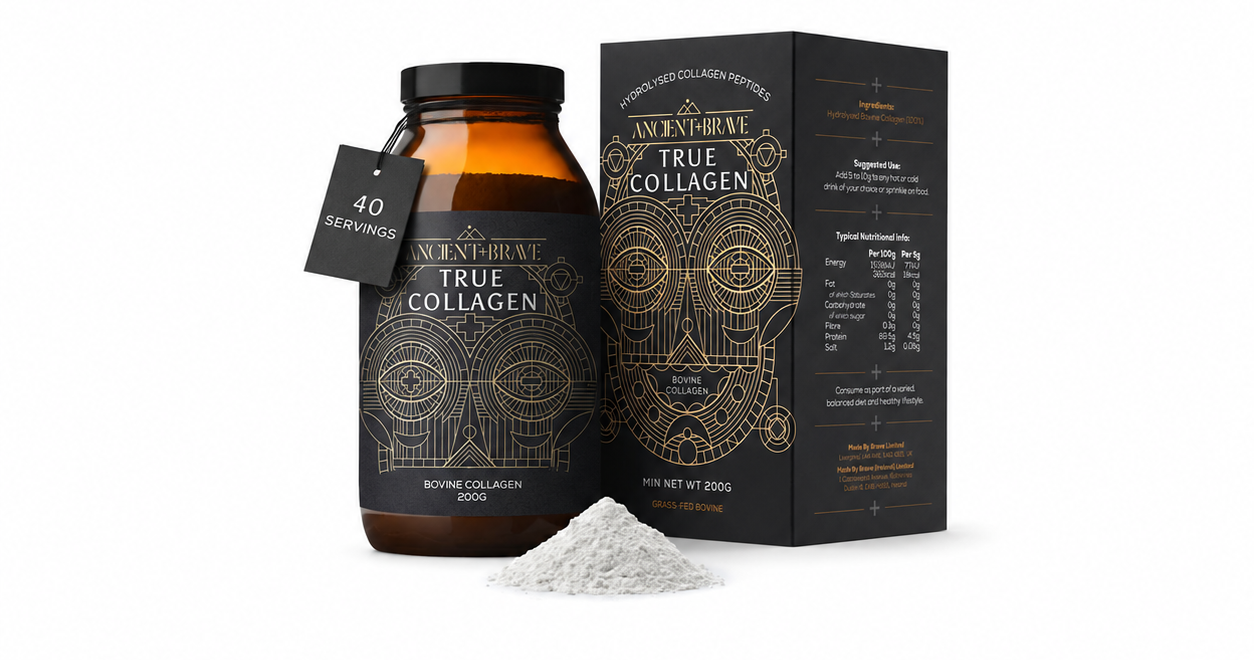
One ingredient, a B Corp behind it, and unusually well-behaved in the cup — genuinely tasteless, and it dissolves in hot coffee. It is also sold with claims that no authorised health claim exists to support, at a serving count that only works at a dose the brand does not recommend.
One ingredient, four doses
The ingredient list is a single line: hydrolysed bovine collagen, 100%. No fillers, no flavourings, nothing to decode. On formulation alone that is about as clean as a label gets.
The dose is the opposite. Four different figures appear on the same page.
A buyer working out cost per day cannot do it, and one four-star reviewer said so directly, calling the guidance on how much to use vague. Two others mention the measuring scoop: one bought it separately to be sure of the amount, another was annoyed it was not included. For a product where the dose is the only variable, that is a strange thing to leave loose.
Collagen has no authorised claims
This is worth knowing before you read the claims on the page.
This copy is the brand’s own product description rather than a retailer-written title, and it is not a wording slip either — it is a list of six body systems.
Worth being fair about what this does and does not mean. It does not mean the claims are false. It means no regulator has assessed the evidence and found it sufficient, which for a widely sold ingredient is itself informative.
What the trials actually show
There is real research here, and it deserves a fair hearing rather than a dismissal.
Systematic reviews of hydrolysed collagen and skin pool roughly twenty randomised trials and over a thousand participants, and do find small but statistically significant improvements in skin hydration and elasticity after eight to twelve weeks. That is a genuine signal. The caveats are equally real: most trials are small, most are funded by collagen manufacturers, and many test combination products containing vitamin C, biotin or hyaluronic acid, which makes it hard to attribute anything to the collagen alone.
The bigger problem for this listing is which collagen. The skin and joint trials used specific, patented, characterised peptides at specific molecular weights and doses. Hydrolysed collagen is not one substance; peptide size and profile differ between suppliers, and those differences are precisely what the patents cover. This page says “clinically researched” and “clinically proven” without naming a single peptide, study or supplier. A brand using a studied peptide normally says so on the front of the pack, because it is the main thing worth paying for.
On nails and hair the evidence is thinner still — the best-known nail study was small and had no control group. And no vitamin C is included, despite it being required for the body to build collagen at all and present in many of the trials.
“Excellent protein source”
The description calls this an excellent protein source, ideal for fasting and keto. Two problems.
Collagen contains no tryptophan, which makes it an incomplete protein with a very low protein quality score — it cannot substitute for whey, eggs or soy in the way the phrase implies. It is about a third glycine, and useful as a glycine source, but that is a different argument from the one being made.
“Ideal for fasting” is also loose: 5 to 7 g of protein in a coffee is not a fasted state by any definition a metabolic researcher would use. No protein content per serving is published anywhere on the listing, so a reader cannot check either statement. One further line worth flagging: “no hormones, antibiotics, or GMOs” reads as a differentiator, but hormone treatment of cattle has long been prohibited in the UK and EU.
What buyers report
Amazon’s topic breakdown, from a much larger sample, confirms the format and contests the price.
Verdict
- Works
- One ingredient at 100% — no fillers or flavourings
- Taste 201 mentions to 35, solubility 83 to 7
- Dissolves in hot drinks, which many powders will not
- Type I, European hides, sourcing disclosed
- Certified B Corp; 1% for the Planet
- Real, if modest, trial evidence for skin hydration and elasticity
- Doesn’t
- Four different doses stated on one page
- “40 servings” only holds at 5 g, below the brand’s own 7 g
- Skin, hair, nail, joint, bone and gut claims are not authorised
- “Clinically researched” with no peptide, study or supplier named
- “Excellent protein source” — collagen has no tryptophan
- No nutrition panel, protein or amino acid figures
- Testing claimed but no lab or certificate given
- No vitamin C, which most trials included
- Measuring scoop sold separately
Worth it if you want a plain, well-sourced collagen from a company whose ethics disclosures are unusually thorough, you will actually take it daily for three months or more, and you are comfortable that the skin evidence is modest and the hair and nail evidence weak.
Skip it if you want a peptide that matches the ones used in trials, in which case buy a product that names it; if you are vegetarian or vegan; if you want to know the protein content or cost per day; or if you are buying it as a protein source, which it is not.
Check with a pharmacist if you have a history of kidney stones, since collagen is high in hydroxyproline and oxalate precursors, if you are on a protein-restricted diet, or if you have a beef allergy.
How we score
Every supplement in this section is judged on the same six criteria, weighted as below. We score the product that left the factory — the formula, the dose, the pack — not the way a retailer has written the listing. Marketing wording is worth pointing out, and we do, but it does not move the score.
Each criterion is scored out of 10 against the norm for its category, not against an ideal: 10 is best practice, 8 solid with minor gaps, 6 works but with a real limitation, 4 a serious shortfall, 2 should not be on the shelf. The overall figure is the weighted average, printed to one decimal place, and the paragraph under the table explains where the marks went.
How we review: every supplement is scored on the same six criteria — formulation 25%, dosing against the evidence 25%, real-world record 20%, value 15%, practicality 10%, transparency 5%. The real-world score reflects the product’s customer rating and, just as importantly, how many ratings stand behind it: tens of thousands of buyers tell you something a desk review cannot, while a few hundred tell you very little. We buy nothing from the brands we cover and take no payment for placement. General information, not medical advice.