
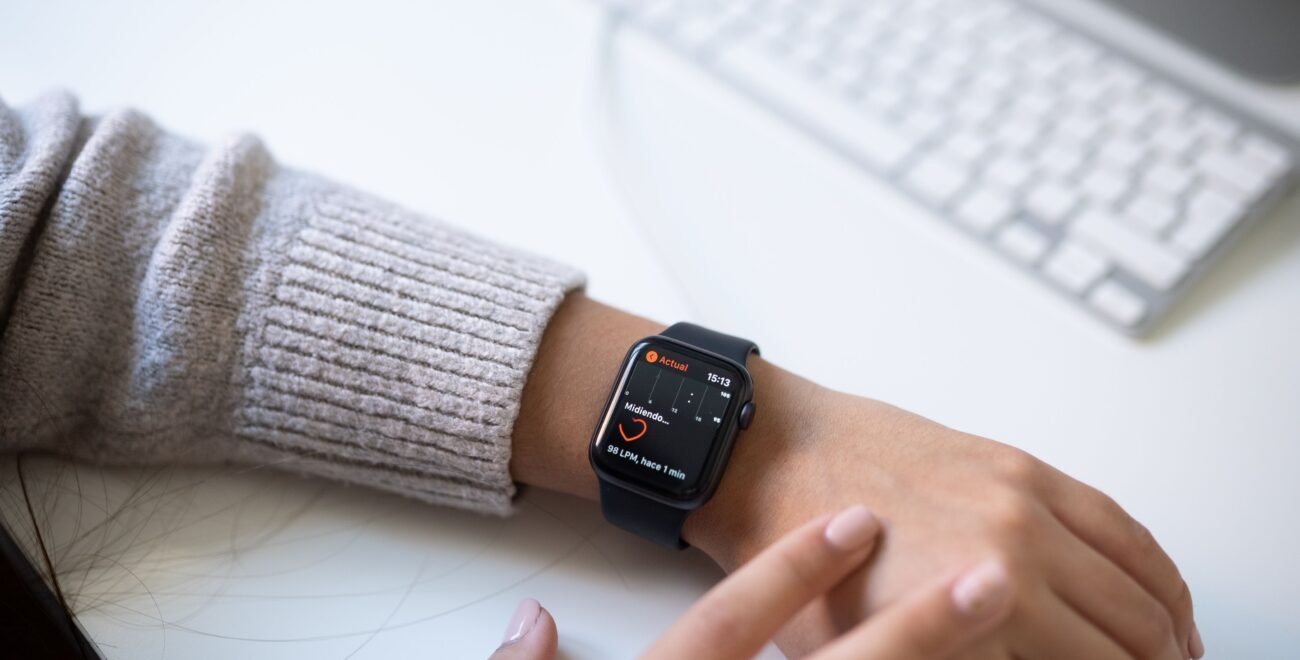
Resting heart rate is one of the most accessible health markers you have — sitting on your wrist or your smartwatch every morning. Here is what the numbers mean, what changes them, and when to pay attention.
Most health metrics require a lab visit. Resting heart rate is one of the rare ones you already have, updated daily, and it turns out to carry more genuine predictive weight than its casual treatment in fitness apps suggests.
The normal range, and why “normal” isn’t the full story
The standard reference range for adults is 60 to 100 beats per minute. But within that range, and even below it, there’s real signal — this isn’t a metric where anything in the “normal” bucket is equivalent. Multiple large studies have found a graded relationship between resting heart rate and mortality risk that holds even within the normal range: one large cohort study found each 10 bpm increase in resting heart rate was associated with roughly an 11% higher risk of cardiovascular disease, an 8% higher cancer risk, and a 17-22% higher all-cause mortality risk (figures vary somewhat by study population, but the direction and rough magnitude are consistent across multiple independent cohorts). This isn’t a threshold effect where you’re “fine” until you cross 100 — the relationship trends continuously, with lower generally better, across most of the normal range.

Why lower usually means something good — but not without exception
A lower resting heart rate is generally a sign of good cardiovascular fitness: a heart trained by regular aerobic exercise pumps more blood per beat, so it needs fewer beats to circulate the same volume, which is why well-conditioned athletes commonly sit in the 40-60 bpm range without any cause for concern. This is technically bradycardia (below 60 bpm) by clinical definition, but athletic bradycardia driven by genuine fitness is a well-recognized, benign pattern, not something to worry about on its own.
The distinction that actually matters clinically isn’t the number alone — it’s the number plus symptoms. A low resting heart rate paired with dizziness, fatigue, fainting, or shortness of breath is a different situation entirely from the same number in someone who feels fine and trains regularly; the first warrants medical evaluation, the second generally doesn’t. Research has also found that the relationship between heart rate and outcomes isn’t perfectly linear at the extremes — heart block and certain conduction abnormalities can also produce a low heart rate, and unlike athletic bradycardia, these carry real risk. The number by itself, without context, doesn’t tell you which situation you’re in.
What actually moves the number
Resting heart rate isn’t fixed — it responds to a range of factors, some of which you can influence and some you can’t:
- Cardiovascular fitness is the biggest modifiable lever. Regular aerobic exercise measurably and reliably lowers resting heart rate over weeks to months as the heart becomes more efficient.
- Sleep, stress, and illness all push it upward temporarily — a resting heart rate that’s noticeably higher than your personal baseline on a given morning is a reasonably reliable early signal of poor sleep, oncoming illness, or unusual stress, often before you consciously feel it.
- Dehydration, caffeine, and certain medications can shift it in the short term without reflecting any change in underlying fitness or health.
- Age and body size play a role too, along with genuine individual variation — there’s a wide range of what’s normal for different people, which is part of why a personal baseline matters more than comparing your number to someone else’s.
Why the trend matters more than any single reading
One of the more useful, less commonly discussed findings from recent research: it’s not just your resting heart rate at a single point in time that predicts outcomes — it’s the direction it moves over years. A large longitudinal study found that people whose resting heart rate trended upward over time, even a slight increase, had a substantially higher risk of developing heart failure than those whose resting heart rate trended downward or stayed stable, independent of what their number was to begin with. This is the strongest practical argument for tracking resting heart rate over months and years, rather than checking it once and filing the number away — a smartwatch or fitness tracker that logs it daily is actually well suited to catching a gradual trend that a single annual checkup reading would miss entirely.
The practical takeaway
Know your personal baseline rather than comparing yourself to a generic range — check it first thing in the morning, before getting up, for genuine accuracy. A number that’s meaningfully higher than your own normal, especially if it’s a sustained shift rather than a one-off, is worth paying attention to, whether that means resting more, addressing a stressor, or checking in with a doctor if it persists without an obvious cause. And if you’re a low-heart-rate athlete without symptoms, the number alone isn’t something to worry about — but if a low number ever comes with dizziness or fatigue, that combination, not the number in isolation, is the actual signal to get checked.
Sources
- Seviiri M, et al. Longitudinal study of resting heart rate change and cardiovascular, cancer, and all-cause mortality risk (Melbourne cohort).
- Research on resting heart rate as an independent predictor of cardiovascular and all-cause mortality, ScienceDirectclinical reviews.
- American Heart Association. “Abnormal resting heart rate over long term may predict future heart failure or death,” longitudinal cohort research, 2024.
- Research on athletic bradycardia and long-term cardiovascular prognosis in trained athletes.