
Weight is a single number that conflates muscle, fat, bone, and water. Here is what body composition actually tells you — and how to improve it.
Two people can stand on the same scale, read the same number, be the same height, and have entirely different metabolic risk profiles. That is not a quirk at the margins — it is the predictable result of using one figure to summarise four things that behave differently. The useful question was never how much you weigh. It is what that weight is made of, and where it sits.
What the scale is actually adding up
Body weight is the sum of fat mass, muscle, bone, organs, and water, and those components respond to different inputs on different timescales. Muscle and fat are the two that move most in response to diet and training, and they move in opposite directions under the right conditions — which is precisely why the scale can sit still while the body underneath it changes substantially.


Water alone accounts for most of the day-to-day noise. Glycogen, the body’s stored carbohydrate, binds roughly three grams of water for every gram stored, so a high-carbohydrate day, a salty meal, a hard training session, or a point in the menstrual cycle can each shift scale weight by a kilogram or more within 24 hours. None of that is fat gained or lost. A daily weigh-in measures hydration status at least as much as it measures anything anyone actually cares about.
What BMI was built for, and what it was not
Body mass index was devised in the 1830s by a Belgian statistician, Adolphe Quetelet, who was studying the distribution of physical characteristics across populations. He was explicit that it described groups, not individuals. It re-entered medicine in the 1970s as a cheap epidemiological screening tool, and it works reasonably well for that: across large populations, BMI tracks with health outcomes.
Applied to one person, it has an obvious blind spot. BMI cannot distinguish a kilogram of muscle from a kilogram of fat, so it misclassifies muscular people as overweight and — more consequentially — misses people whose BMI is normal but whose body fat is high. That pattern, sometimes called normal weight obesity, has been associated in cohort research with cardiometabolic dysregulation and elevated cardiovascular risk despite a reassuring number on the chart. The scale said nothing was wrong because the scale could not see what it was measuring.
Where the fat sits matters more than how much there is
Fat is not one tissue with one behaviour. Subcutaneous fat, stored under the skin, is largely inert metabolically. Visceral fat, packed around the abdominal organs, is metabolically active: it releases inflammatory signalling molecules and free fatty acids directly into the portal circulation, and it is far more strongly associated with insulin resistance, dyslipidaemia, and cardiovascular risk than total fat mass is.
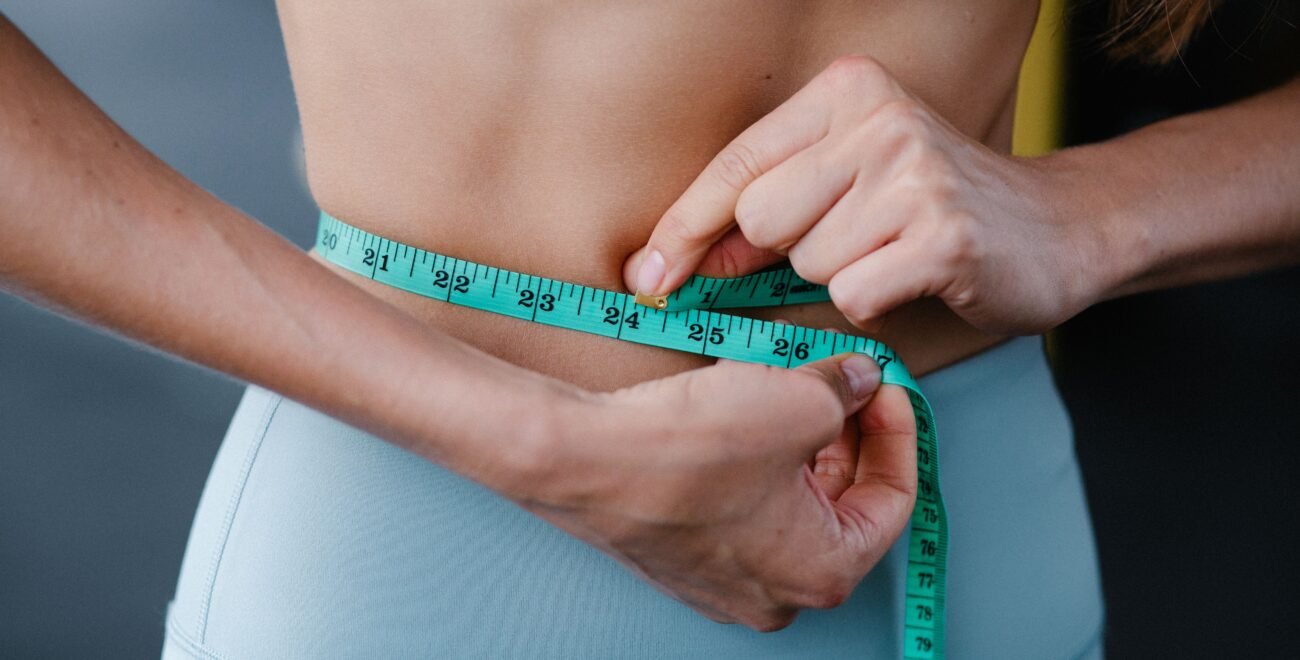
This is why waist measurement earns its place as the most useful low-tech tool available. Waist-to-height ratio in particular — waist circumference divided by height, with 0.5 as the common threshold — has performed better than BMI in systematic reviews of cardiometabolic risk screening, and it needs nothing but a tape measure. It is not a body composition measurement in the strict sense. It is a proxy for the compartment that matters most, which is often the more useful thing.
The scale said nothing was wrong because the scale could not see what it was measuring.
— WellnessLife editorial
How to actually measure composition
The available methods trade accuracy against cost and convenience, and the honest framing is that none of the accessible ones are precise enough to take a single reading seriously.
DEXA scanning is the practical reference standard outside research settings, separating fat, lean tissue, and bone, and reporting regional distribution. It is accurate to within a couple of percentage points but requires a clinic visit and a fee. Bioelectrical impedance — the technology in smart scales and handheld devices — passes a small current through the body and estimates composition from resistance. It is cheap and instant, and its error margin is wide, because hydration, recent food, recent exercise, and skin temperature all move the reading. Skinfold calipers can be reasonably accurate in trained hands and are unreliable in untrained ones.
The practical resolution: pick one method, use it under identical conditions, and read the trend over months rather than the number on any given day. A home impedance scale that is consistently wrong in the same direction still shows you which way things are moving, which is most of what you need.
- BMI was designed as a population statistic and cannot distinguish muscle from fat in an individual
- Normal BMI with high body fat is associated with cardiometabolic risk that the BMI reading conceals
- Visceral fat, not total fat, drives most of the metabolic risk — which is why waist measurement adds information the scale cannot
- Waist-to-height ratio under 0.5 has outperformed BMI as a screening threshold in systematic reviews
- Glycogen binds around three grams of water per gram stored, so daily scale swings of a kilogram are routine and mean nothing
- Weight lost through diet alone includes a substantial proportion of lean tissue; resistance training and adequate protein reduce that share
- Protein intake benefits for muscle retention plateau around 1.6 g per kg of bodyweight daily in meta-analysis — more has not been shown to add much
What actually shifts composition
The single most consequential finding here is about what happens during weight loss. A calorie deficit alone does not selectively remove fat; a meaningful share of the tissue lost is lean mass, and losing muscle lowers total energy expenditure, which is part of why weight regain is so common after aggressive dieting. Resistance training during a deficit substantially changes that ratio, and adequate protein supports it — meta-analysis puts the point of diminishing returns at roughly 1.6 grams per kilogram of bodyweight per day, well below what supplement marketing implies but above what many people eat while dieting.
The corollary is that a slower deficit generally preserves more muscle than a rapid one, and that “body recomposition” — losing fat and gaining muscle simultaneously — is genuinely achievable, though mainly for people new to resistance training, returning after a layoff, or carrying higher body fat. For a lean, trained person it is slow at best. That is a real limitation, not a motivational obstacle.
The practical takeaway
Keep the scale if it is useful to you, but stop asking it questions it cannot answer. Add a tape measure at the waist and a consistent method of estimating composition, take both under the same conditions, and judge progress over three months rather than three days. If you are trying to lose weight, resistance training two or three times a week and adequate protein are the two things that change what you lose rather than only how much — which is the difference between ending up smaller and ending up better composed. And if your BMI is reassuring but your waist is more than half your height, the reassurance is the part to distrust.
Sources
- Romero-Corral A, Somers VK, Sierra-Johnson J, et al. “Normal weight obesity: a risk factor for cardiometabolic dysregulation and cardiovascular mortality.” European Heart Journal, 2010.
- Ashwell M, Gunn P, Gibson S. “Waist-to-height ratio is a better screening tool than waist circumference and BMI for adult cardiometabolic risk factors: systematic review and meta-analysis.” Obesity Reviews, 2012.
- Morton RW, Murphy KT, McKellar SR, et al. “A systematic review, meta-analysis and meta-regression of the effect of protein supplementation on resistance training-induced gains in muscle mass and strength in healthy adults.” British Journal of Sports Medicine, 2018.
- National Institute for Health and Care Excellence. Obesity: identification, assessment and management — guidance on waist-to-height ratio.
- Comparative validation research on DEXA and bioelectrical impedance analysis for body composition estimation.