Visceral fat — the fat around organs — carries different health risks from fat under the skin. Here is what determines visceral fat levels and what the evidence shows for reducing it.
Fat is not one tissue behaving one way in different places. The fat stored under the skin on your hips and thighs and the fat packed around your liver and intestines differ in blood supply, in what they secrete, and in what they do to your risk of cardiovascular disease and type 2 diabetes. The difference is large enough that two people with identical body fat percentages can have meaningfully different metabolic health depending on where they store it.
Why location changes the risk
The most important anatomical fact here is about plumbing. Visceral adipose tissue drains into the portal vein, which delivers its output directly to the liver before it reaches general circulation. Subcutaneous fat drains into systemic circulation, where its products are diluted across the whole body first.


That matters because visceral fat is metabolically busy. It releases free fatty acids and inflammatory signalling molecules — interleukin-6 and TNF-alpha among them — and it carries a heavier load of infiltrating immune cells than subcutaneous fat does. Delivering that mixture straight to the liver at high concentration is the proposed mechanism behind visceral fat’s associations with hepatic insulin resistance, unfavourable blood lipids, and systemic inflammation.
The corollary is less well known: gluteofemoral fat, stored on the hips and thighs, appears to be actively protective. Larger hip and thigh fat depots are associated with better lipid profiles and lower cardiometabolic risk independent of total body fat. The tissue everyone is encouraged to dislike is, metabolically, the good place to store it.
What determines how much you carry
Several factors sit outside anyone’s control, which is worth stating before the ones that do not.
Sex and hormones. Oestrogen promotes subcutaneous and gluteofemoral storage, which is why premenopausal women typically carry less visceral fat than men at the same body fat percentage, and why the menopausal transition shifts storage toward the abdominal compartment even when total weight is stable.
Genetics. A substantial share of the variation in fat distribution between people is heritable — where you store fat is considerably more genetically determined than how much you store.
Ancestry. People of South Asian descent tend to carry more visceral fat at a given BMI than white European populations, which is part of why several guidelines apply lower BMI and waist thresholds for South Asian adults. Using the standard cut-offs in these groups systematically underestimates risk.
Age shifts distribution toward the visceral compartment independent of weight change, in both sexes.
The modifiable side is shorter but real: overall energy balance, alcohol intake, sleep duration, and — with better evidence than most dietary specifics — fructose from sugar-sweetened drinks. In a controlled trial, ten weeks of fructose-sweetened beverages increased visceral fat specifically, while calorie-matched glucose-sweetened beverages did not.
How to know where you stand
CT and MRI quantify visceral fat directly and are the reference methods; DEXA estimates it reasonably well. None is a routine measurement, and the “visceral fat rating” displayed by home impedance scales is an inference from a whole-body estimate rather than a measurement of the compartment, so it should be read as a rough trend at best.
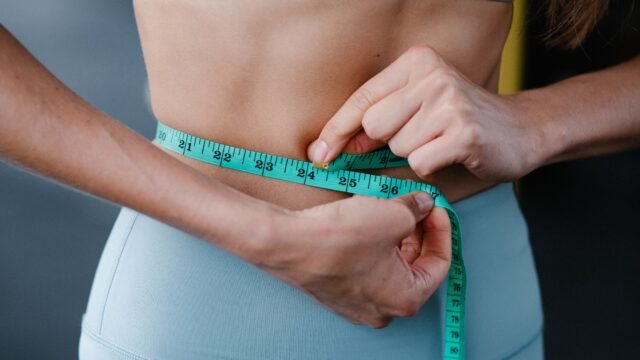
The practical tool remains a tape measure at the waist, interpreted against your height. It is a proxy rather than a direct reading, but it is the proxy that has held up in screening research, and it costs nothing.
What actually reduces it
The encouraging finding, and the one most worth knowing, is that visceral fat is preferentially mobilised. For a given amount of weight lost, the visceral compartment shrinks proportionally more than subcutaneous fat does — it comes off first and fastest. This is why modest weight loss in the range of 5 to 10% of body weight produces metabolic improvements out of proportion to how little changes in the mirror.
Aerobic exercise has the most specific evidence. Systematic reviews consistently find that aerobic training reduces visceral fat, and that it does so even in trials where participants lose little or no weight — the exercise itself mobilises the depot. Comparative reviews generally find aerobic training more effective than resistance training for visceral fat specifically, though resistance training earns its place for preserving muscle and for everything else it does.
Sleep appears in the observational literature: short sleep duration has been associated with greater accumulation of abdominal fat over multi-year follow-up, particularly in younger adults. That evidence is observational and cannot establish cause, but it is consistent with the controlled work on sleep and body composition.
Alcohol is associated with central fat distribution, and its calories are easy to miss in any accounting of intake.
What does not work is targeting. There is no exercise that reduces fat in the region it works, and abdominal training builds the muscle underneath the fat without touching the fat itself. Nothing marketed as a visceral-fat supplement has credible trial support.
Visceral fat is the first fat to go — which makes the earliest, least visible progress the most valuable.
— WellnessLife editorial
- Visceral fat drains directly to the liver via the portal vein, delivering fatty acids and inflammatory signals at high concentration
- Gluteofemoral fat on the hips and thighs is associated with better lipid profiles and lower risk, independent of total fat
- Oestrogen favours subcutaneous storage, which is why the menopausal transition shifts fat toward the abdomen without weight necessarily changing
- South Asian populations carry more visceral fat at a given BMI, which standard thresholds underestimate
- Fructose-sweetened drinks increased visceral fat in a controlled trial where calorie-matched glucose drinks did not
- Aerobic exercise reduces visceral fat in trials even where body weight is largely unchanged
- Visceral fat is lost preferentially, so 5–10% weight loss produces metabolic improvement disproportionate to its visible effect
- Spot reduction does not work; abdominal exercises train the muscle beneath the fat, not the fat
The practical takeaway
If your waist measures more than half your height, that is the number worth acting on, whatever the scale says. The evidence points at unremarkable things: regular aerobic exercise, which reduces the depot even if your weight holds steady; a modest, sustained energy deficit if weight loss is appropriate for you; sleep treated as part of the plan; and cutting sugar-sweetened drinks, which is the one dietary specific with a controlled trial behind it for this outcome rather than a general one.
The reason to find that encouraging rather than dull is the preferential mobilisation finding. The compartment doing the most damage responds first, which means the early phase of any reasonable effort — the part that produces the least visible change and the most discouragement — is doing the majority of the metabolic work.
Sources
- Tchernof A, Després JP. “Pathophysiology of human visceral obesity: an update.” Physiological Reviews, 2013.
- Vissers D, Hens W, Taeymans J, et al. “The effect of exercise on visceral adipose tissue in overweight adults: a systematic review and meta-analysis.” PLOS ONE, 2013.
- Stanhope KL, Schwarz JM, Keim NL, et al. “Consuming fructose-sweetened, not glucose-sweetened, beverages increases visceral adiposity and lipids and decreases insulin sensitivity in overweight/obese humans.” Journal of Clinical Investigation, 2009.
- Ismail I, Keating SE, Baker MK, Johnson NA. “A systematic review and meta-analysis of the effect of aerobic vs. resistance exercise training on visceral fat.” Obesity Reviews, 2012.
- Hairston KG, et al. “Sleep duration and five-year abdominal fat accumulation in a minority cohort: the IRAS Family Study.” Sleep, 2010.